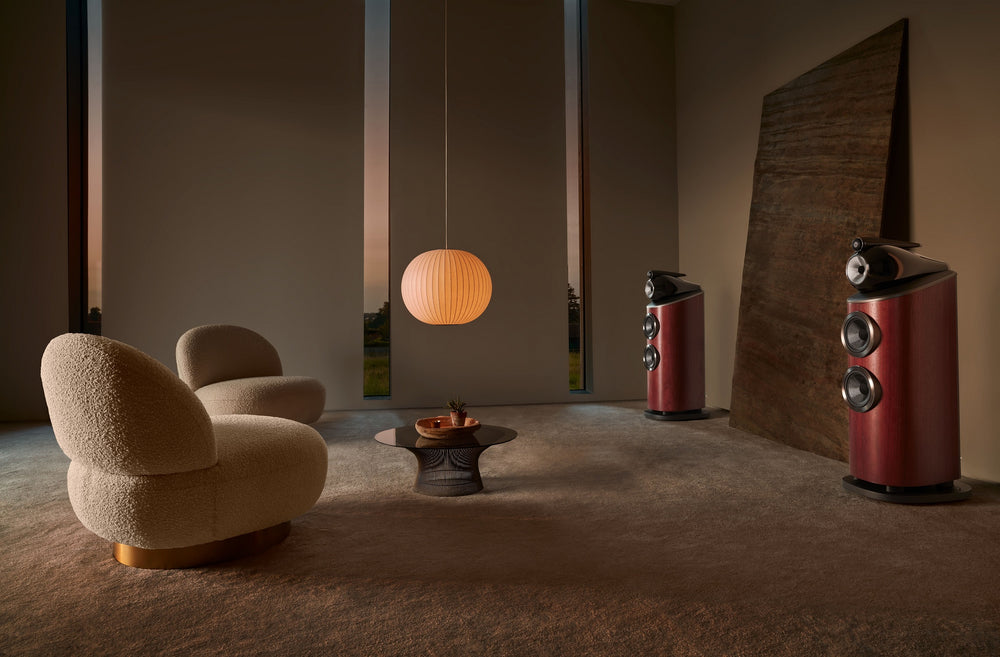
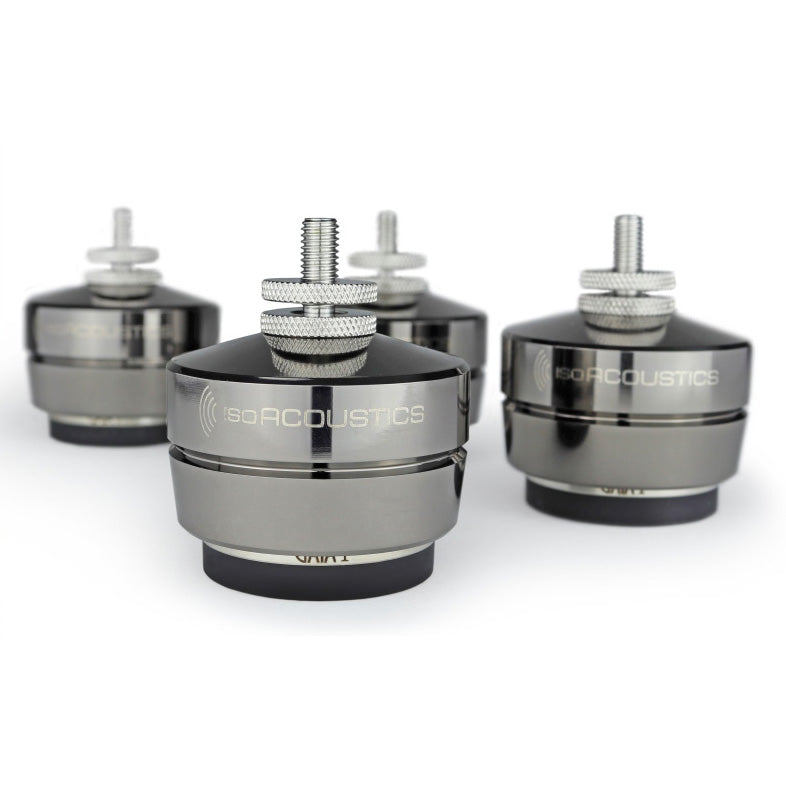
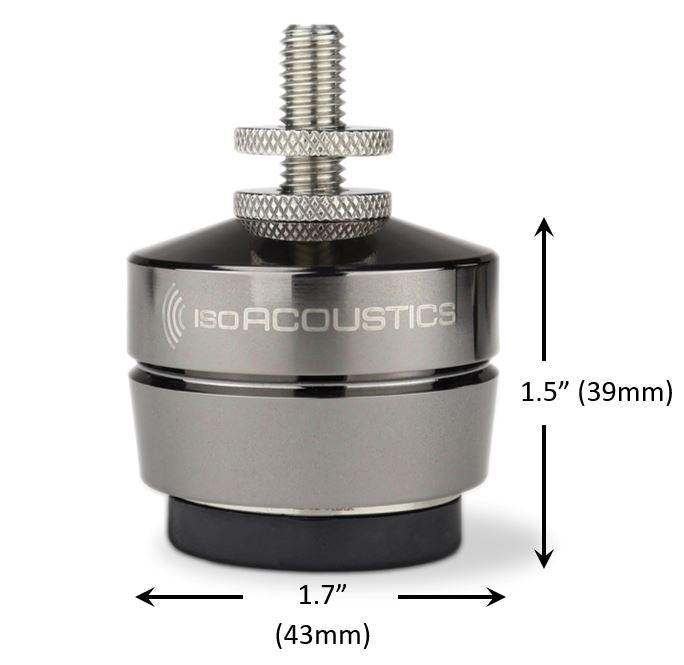
Speaker isolation feet from IsoAcoustics for floorstanding speakers and subwoofers. Each GAIA isolator has a machined dark chrome metal housing and threads into the base of the speaker in place of its existing spikes or feet. Available as GAIA I, GAIA II or GAIA III, with four isolators per box.
IsoAcoustics says GAIA isolators give a high degree of isolation while resisting lateral movement, so the speaker stays aligned with the listening position. It says internal reflections from the hard supporting surface are attenuated, giving greater clarity and openness.
Installing GAIA isolators
Why you will love it
Only the lower isolator touches the floor
IsoAcoustics says some isolation feet rest the metal housing directly on the floor, which creates a rigid path for vibration. In a GAIA, only the lower isolator contacts the surface.
IsoAcoustics says this means vibrations are not transmitted through the housing. It describes the result as a controlled path for energy to dissipate, with greater clarity, openness and focus.

Threaded fitting with adaptors included
GAIA isolators thread into the base of the speaker or subwoofer to replace the existing spikes or feet. IsoAcoustics says this strong connection means all the energy is managed by the GAIA's internal isolator.
Thread adaptors are included: M8-1.25, M12-1.25 and 1/4"-20 for the GAIA I, and M6-1.0, M8-1.25 and 1/4"-20 for the GAIA II and GAIA III. IsoAcoustics says other sizes are available on request through its distributors.
Choose by speaker weight
The GAIA I suits speakers up to 100 kg, the GAIA II up to 54 kg and the GAIA III up to 32 kg. IsoAcoustics lists these limits for a set of four.
IsoAcoustics says GAIA isolators perform well up to their weight limit, but within 10% of the limit it recommends the next size up. It does not recommend exceeding the limits.
Is it right for you?
A great fit if you…
- Have floorstanding speakers or a subwoofer with threaded inserts in the base
- Want to replace spikes or feet with isolation feet
- Want to reduce vibration passing into the floor
- Want a compact metal-housed isolator
Worth knowing
- Your speaker needs a threaded base. IsoAcoustics does not recommend GAIA for speakers without threads and suggests its OREA series instead
- Each box holds four isolators, and the weight limits apply to the set of four
- Install with the logo facing the listening position, or rotated 180 degrees
- On thicker carpet, IsoAcoustics says GAIA carpet disks help the isolators connect to the floor
Build your system
GAIA isolators suit floorstanding speakers and subwoofers. IsoAcoustics Aperta stands suit bookshelf speakers.
- Floorstanding speakers: Browse floorstanding speakers
- Subwoofers: Browse subwoofers
- Bookshelf speakers: Use IsoAcoustics Aperta stands for bookshelf speakers
Specifications
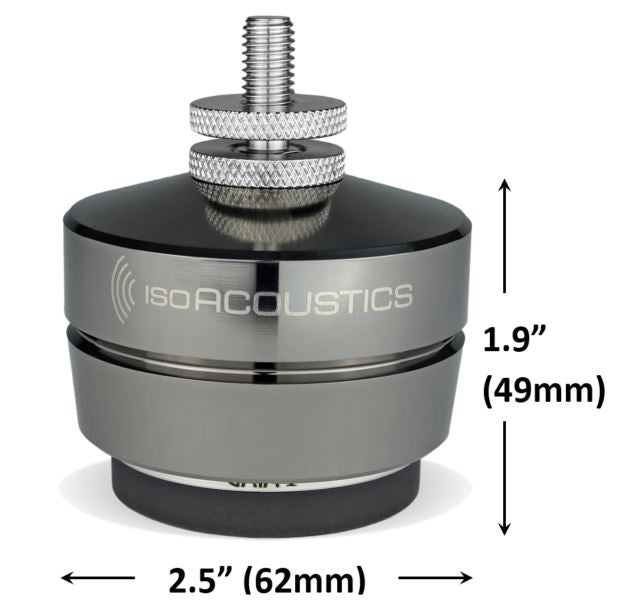
GAIA I
| For | Floorstanding speakers and subwoofers up to 100 kg (220 lbs) per set of 4 |
|---|---|
| Size (W x H) | 62 x 49 mm (2.5 x 1.9 in) |
| Quantity | 4 per box |
| Thread sizes included | M8-1.25, M12-1.25, 1/4"-20 |
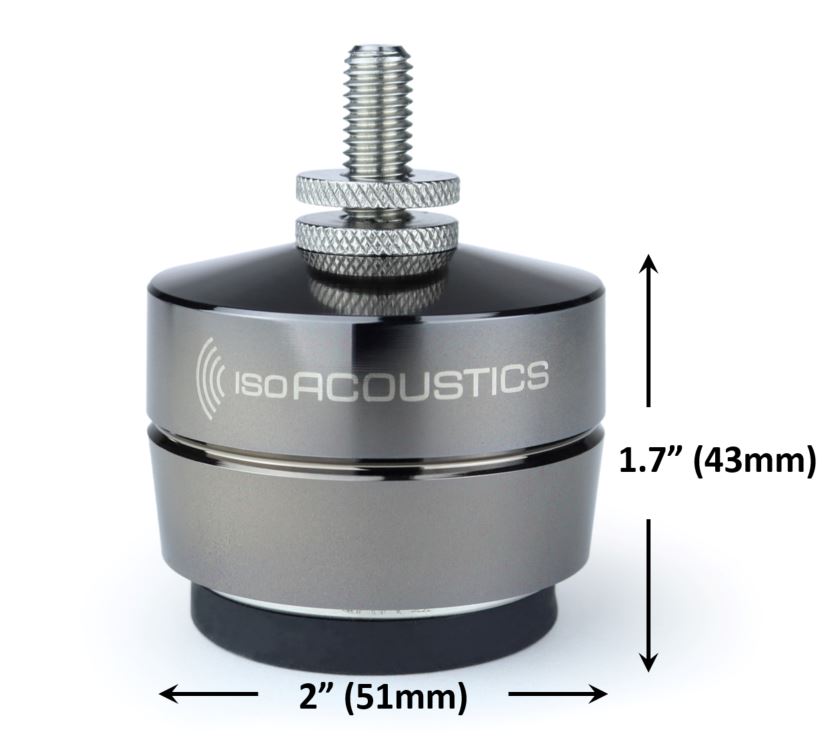
GAIA II
| For | Floorstanding speakers and subwoofers up to 54 kg (120 lbs) per set of 4 |
|---|---|
| Size (W x H) | 51 x 43 mm (2 x 1.7 in) |
| Quantity | 4 per box |
| Thread sizes included | M6-1.0, M8-1.25, 1/4"-20 |
GAIA III
| For | Floorstanding speakers and subwoofers up to 32 kg (70 lbs) per set of 4 |
|---|---|
| Size (W x H) | 43 x 39 mm (1.7 x 1.5 in) |
| Quantity | 4 per box |
| Thread sizes included | M6-1.0, M8-1.25, 1/4"-20 |
Specifications as published by IsoAcoustics.
What is in the box
- Four IsoAcoustics GAIA isolators (GAIA I, GAIA II or GAIA III as selected)
- Thread adaptors for the sizes listed above
Questions people ask
Which GAIA do I need?
Choose by the weight of the speaker or subwoofer: GAIA I up to 100 kg, GAIA II up to 54 kg, GAIA III up to 32 kg, per set of four. IsoAcoustics suggests the next size up if you are within 10% of a limit.
How do they fit?
They thread into the base of the speaker in place of its spikes or feet. Adaptors for common thread sizes are included.
Can I use them if my speaker has no threads?
IsoAcoustics does not recommend GAIA for speakers without threads. It suggests the OREA series as an alternative.
Which way should the logo face?
IsoAcoustics says the logo should face the listening position, or be rotated 180 degrees to face the rear.
Do they work on all floors?
IsoAcoustics says isolation is effective on all types of flooring, including hard concrete. For thicker carpet it offers GAIA carpet disks.