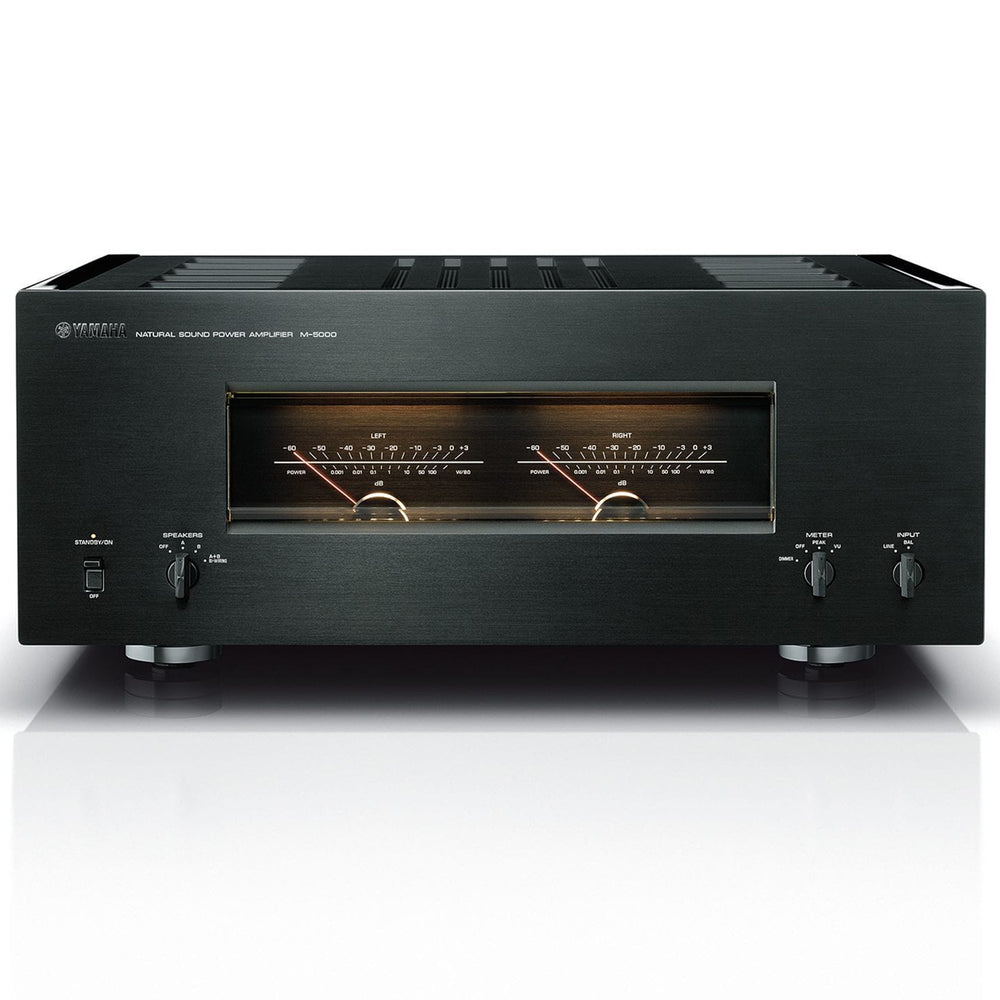
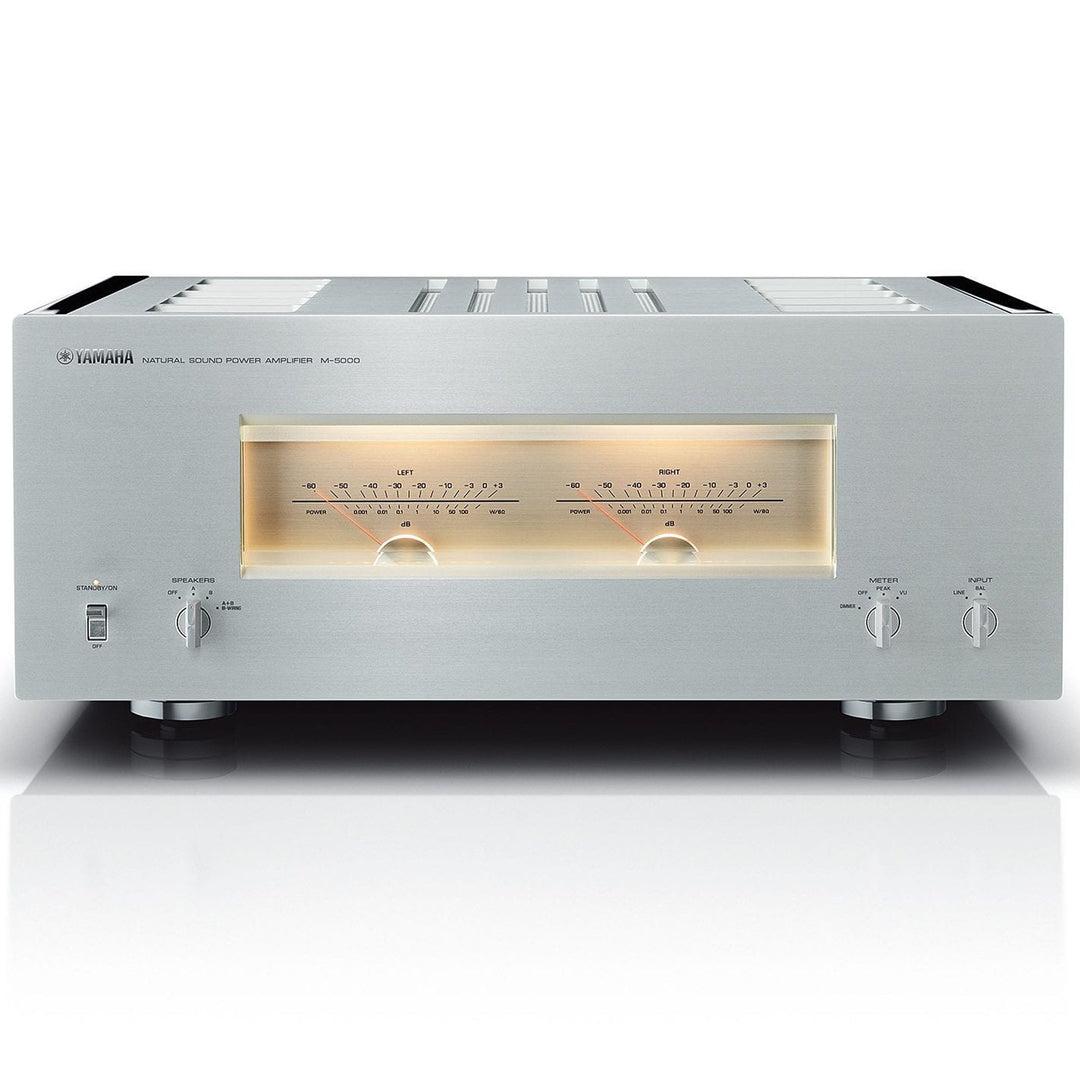
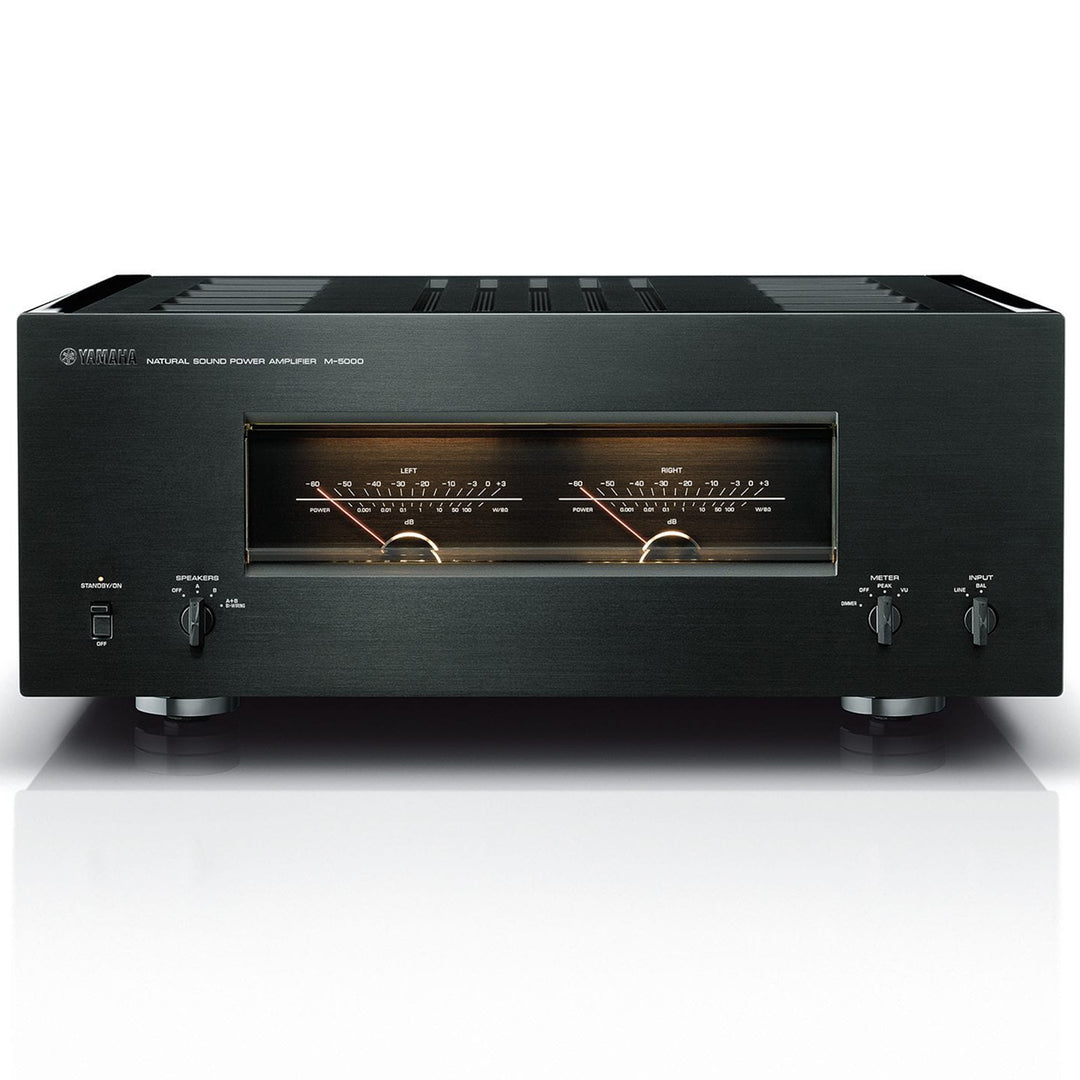
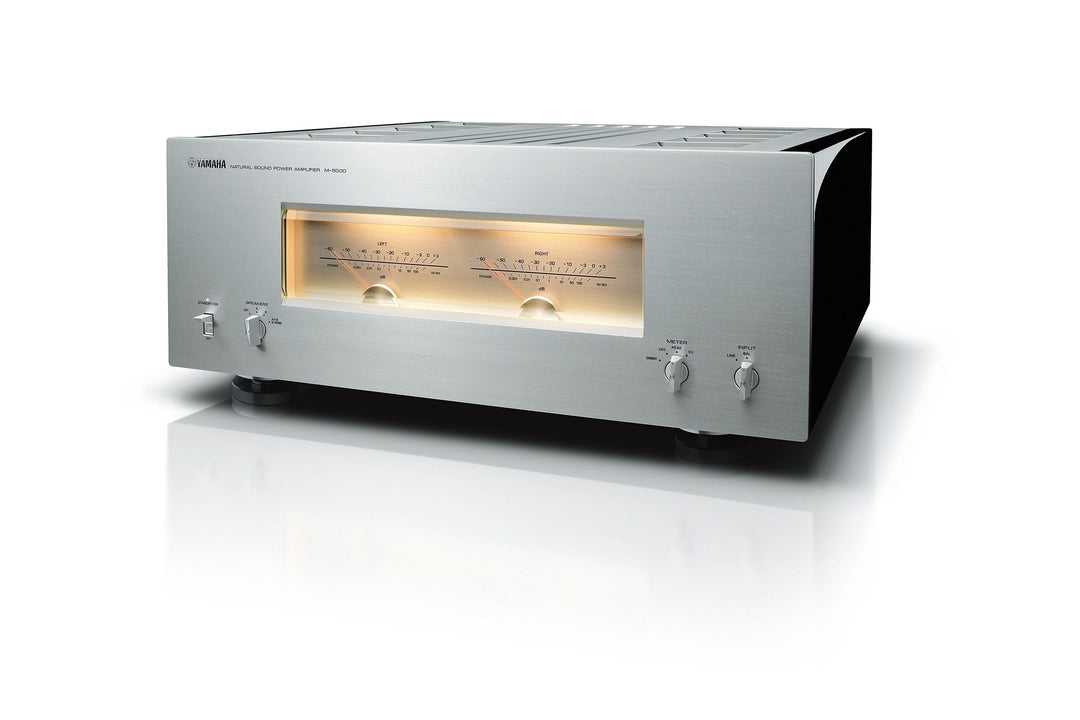
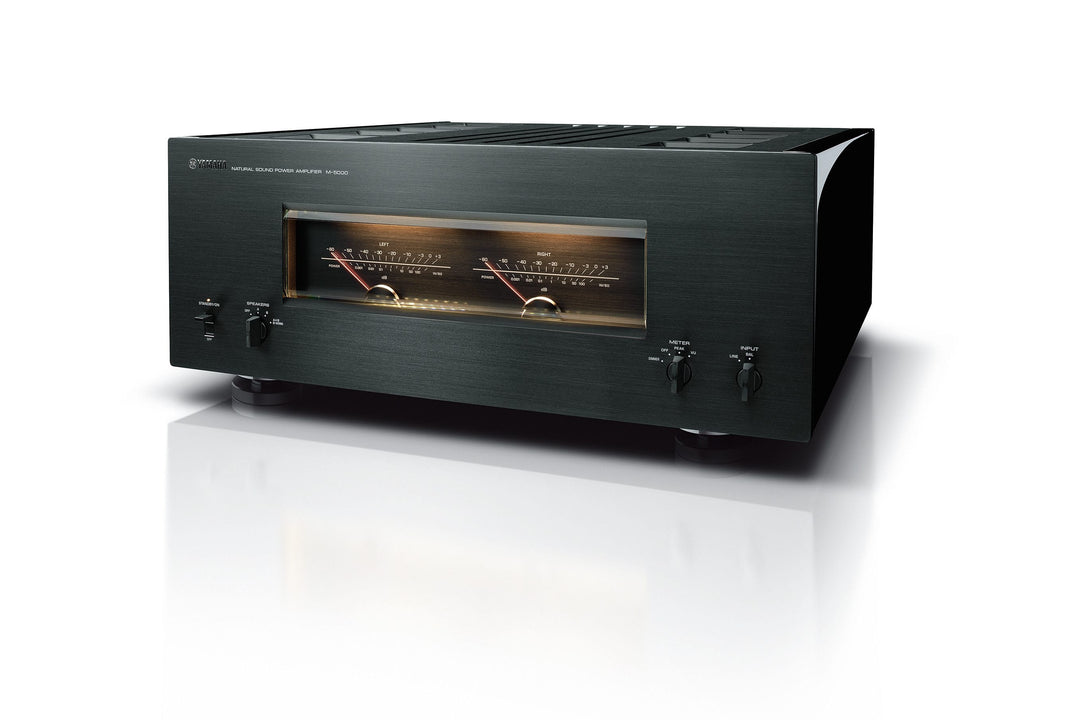
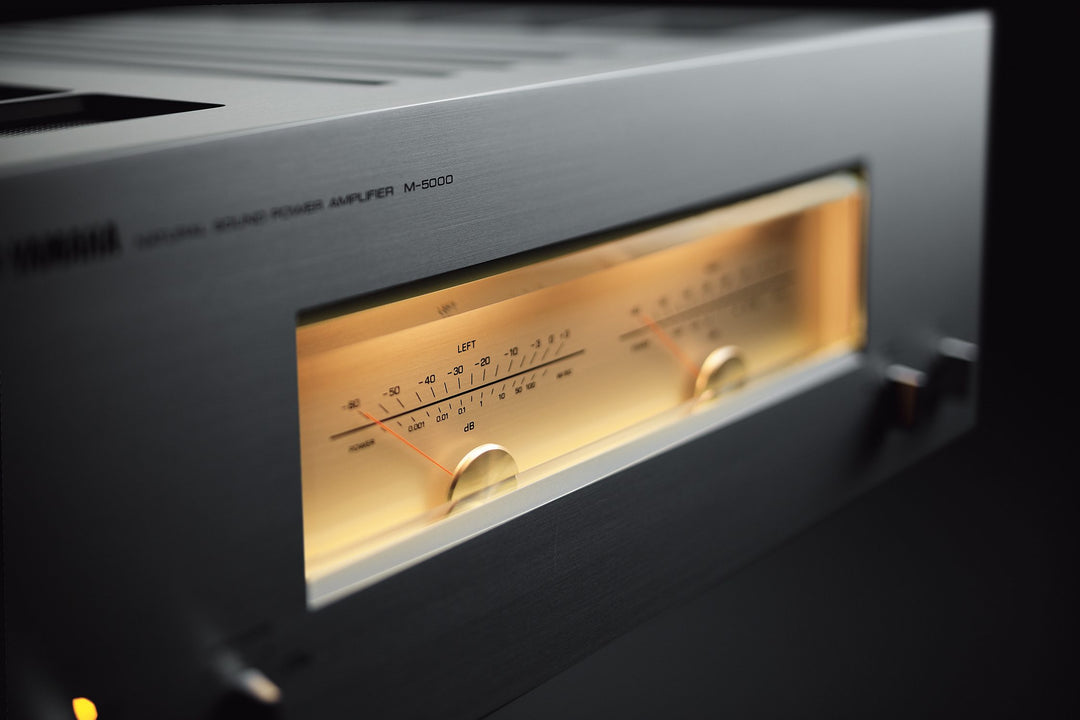
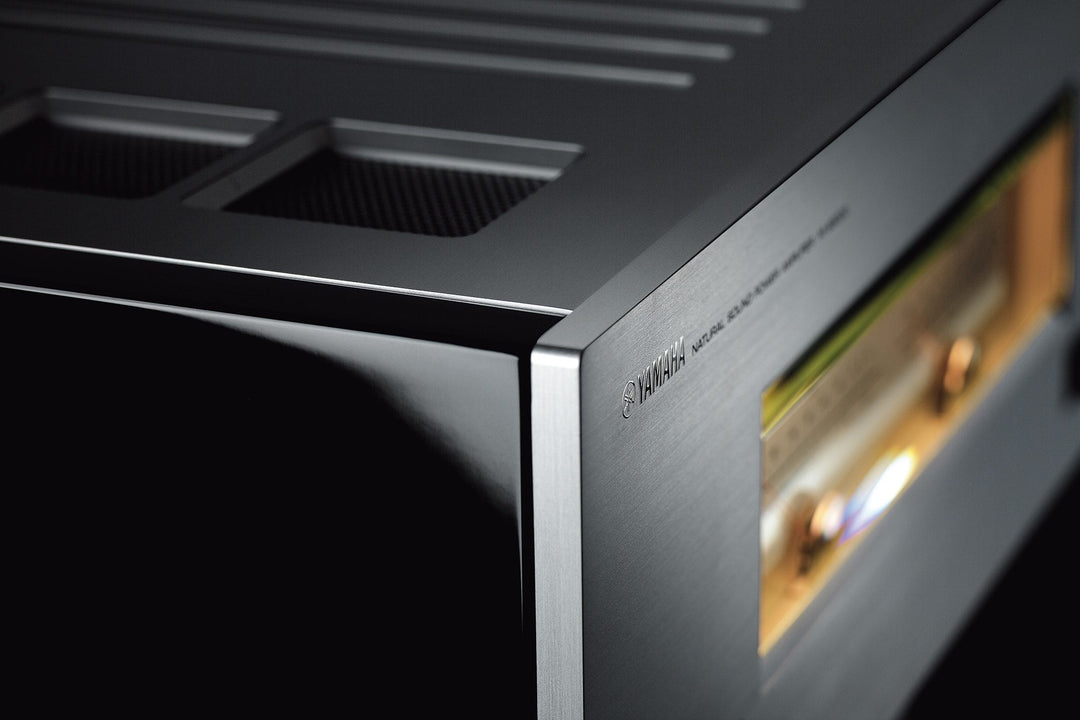
A stereo power amplifier from Yamaha rated at 100 W + 100 W into 8 ohms and 200 W + 200 W into 4 ohms (2-channel driven). It has a floating and balanced MOSFET power amplifier design, balanced XLR and RCA inputs, and a mode switch for stereo, bi-amp or bridge use. Available in Silver or Black.
Yamaha says the M-5000 is built around a symmetrical layout that separates the left and right channels physically and electrically. It is a power amplifier, so it needs a preamplifier or other source with volume control.
Why you will love it
Floating and balanced MOSFET power amplifier
Yamaha says the power supply is connected directly to the positive and negative sides of the output stage, and the whole power amplifier circuit is floated from ground. Yamaha says this removes the effect of small voltage fluctuations and ground noise.
Yamaha says the layout suits MOSFET power devices and improves drivability for low-impedance speakers. Yamaha also lists full floating and balanced transmission from input to output.

Symmetrical, rigid construction
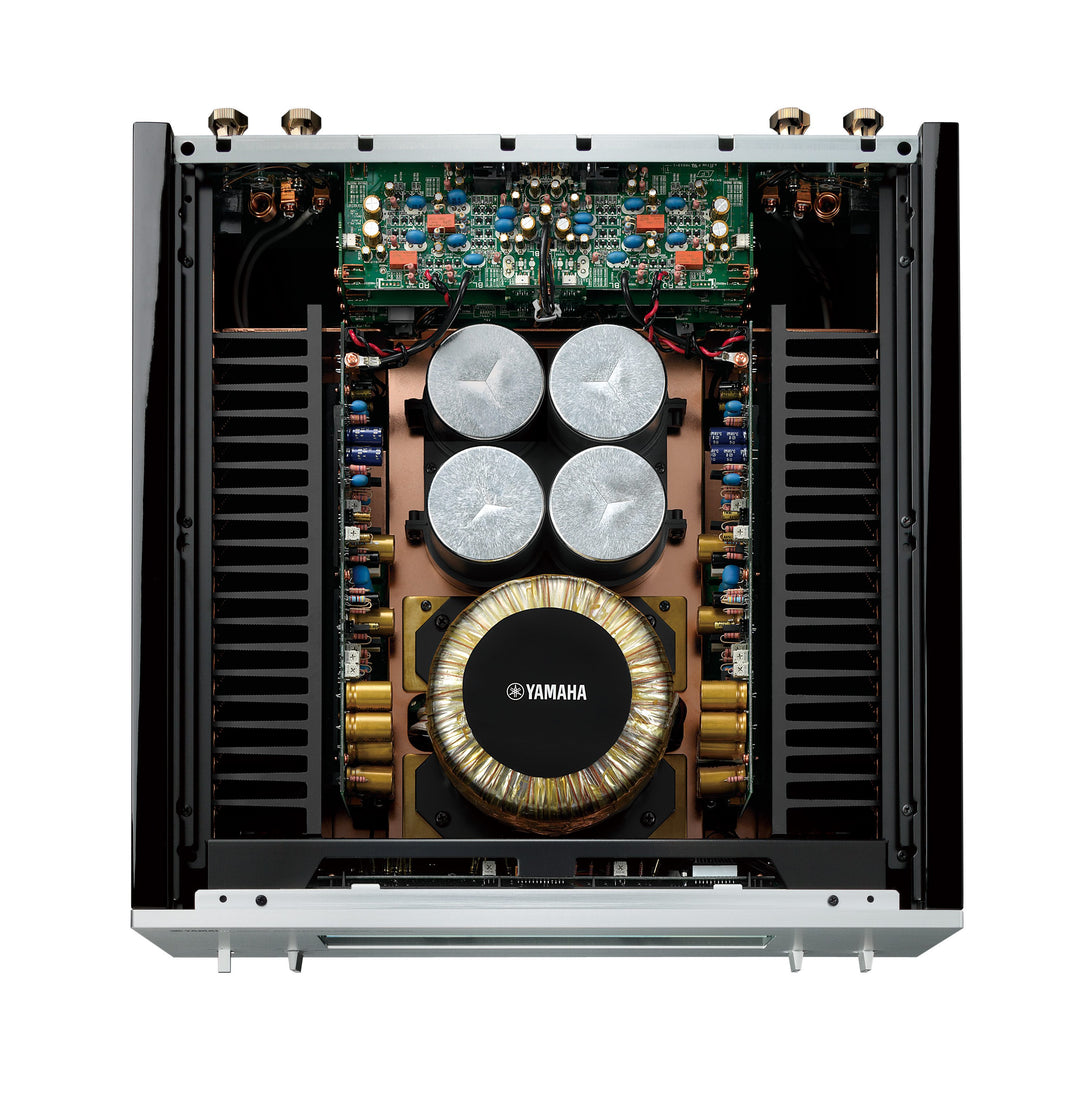
Yamaha says the left-right symmetrical layout and short signal and power paths keep impedance low. The power transformer, block capacitors and heat sink are bolted to a rigid frame in what Yamaha calls a mechanical ground concept, to reduce the influence of vibration.
Yamaha lists a large toroidal transformer on a 3 mm pure brass base. Yamaha also lists four separate power supply circuits with four 33,000 uF capacitors, and brass spiked feet that can also be used with a scratch guard base.
Level meters and speaker terminals
The front panel has two large level meters made from 7 mm thick Asahi glass. A selector switches the display between peak and VU, or turns it off, and a dimmer adjusts the brightness.
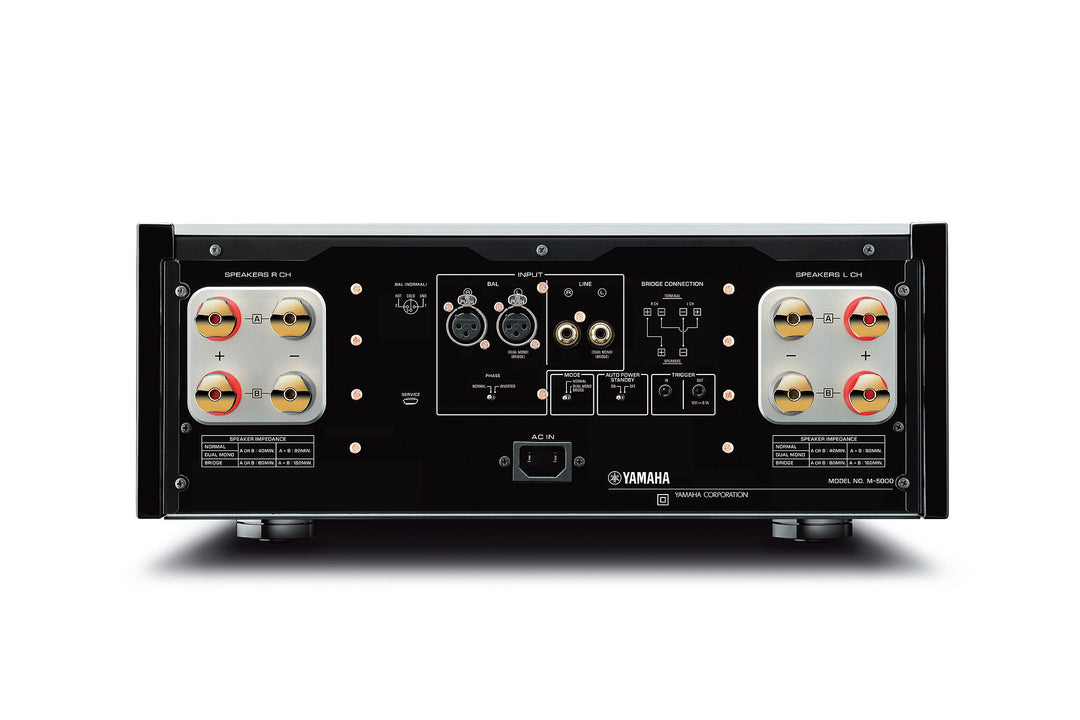
Yamaha lists oversized screw-type speaker terminals cut from a pure brass block, with a 3 mm brass base plate. A front panel selector switches speakers A, B or A+B / bi-wiring.


Stereo, bi-amp or bridge
A rear mode selector sets the M-5000 as a stereo amplifier (Normal) or as a monaural amplifier (Dual Mono / Bridge) for bi-amp or bridge connections. Yamaha says two M-5000 units are needed for a stereo bi-amp or bridged system.
Driven in monaural into 8 ohms, Yamaha lists 400 W. In bridge mode Yamaha requires speakers of 8 ohms or higher.
Inputs are one balanced XLR pair and one RCA pair, chosen by a front panel selector, with a phase selector for the XLR inputs. Trigger in and out jacks and an auto power standby switch are also fitted.
Is it right for you?
A great fit if you…
- Want a dedicated stereo power amplifier for a separate preamplifier
- Have a preamplifier with balanced XLR or RCA outputs
- Want the option to bi-amp or bridge with a second amplifier later
- Like analogue meters on the front panel
Worth knowing
- It is a power amplifier with no volume control, so it needs a preamplifier or other source with volume control
- Use either the XLR or the RCA inputs, not both at once
- At 26.9 kg and 435 x 180 x 464 mm, it needs a sturdy shelf with room behind it for the connections
- Bridge mode needs speakers of 8 ohms or higher, and a stereo bridged system needs two M-5000 units
- Silver and Black are the available finishes
Build your system
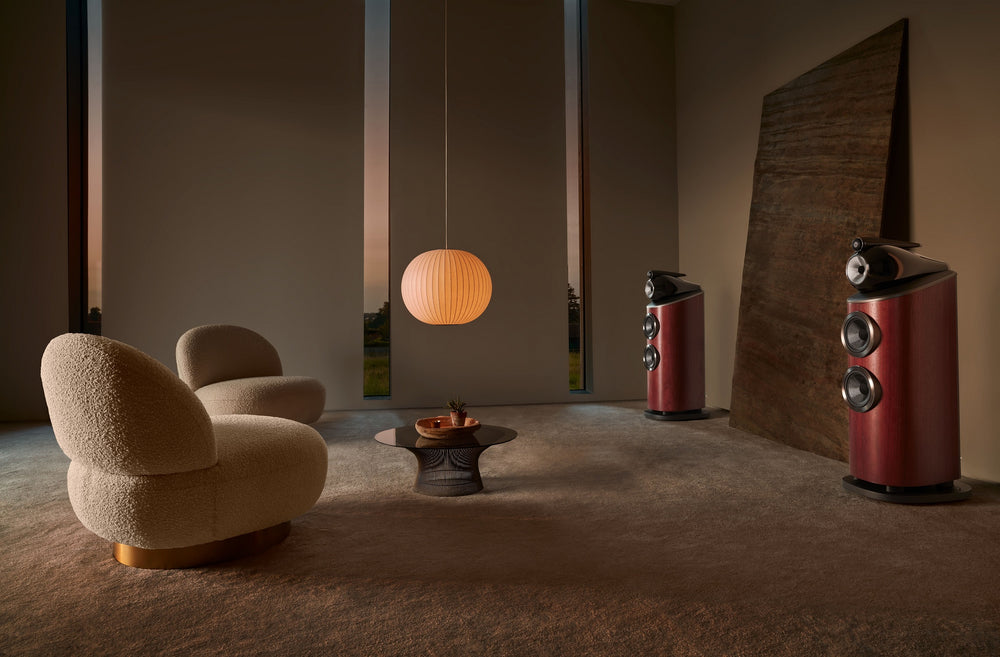
Yamaha shows the M-5000 with the C-5000 preamplifier and the NS-5000 speakers, and says the three together give an end-to-end balanced signal chain.
- Preamplifier: Pair it with the Yamaha C-5000 2-channel pre-amplifier, or browse stereo pre-amplifiers
- Speakers: Yamaha lists the NS-5000 as a related product: see the Yamaha NS-5000 bookshelf speakers, or browse floorstanding speakers
- Other power amplifiers: Compare other power amplifiers
- Integrated amplifiers: If you would rather have one box, see stereo amplifiers
Specifications
Power
| Rated output, 2-ch driven, 20 Hz-20 kHz, 0.07% THD | 100 W + 100 W (8 ohm); 200 W + 200 W (4 ohm) |
|---|---|
| Rated output, monaural driven (8 ohm) | 400 W |
| Dynamic power per channel (IHF) | 125 W + 125 W (8 ohm); 250 W + 250 W (4 ohm); 500 W + 500 W (2 ohm) |
| Power bandwidth | 10 Hz-50 kHz (8 ohm, 0.1% THD, 45 W) |
| Damping factor | 300 or higher (8 ohm, 1 kHz) |
Audio
| Frequency response | 5 Hz-100 kHz (+0 / -3 dB); 20 Hz-20 kHz (+0 / -0.3 dB) |
|---|---|
| THD plus noise (2-ch driven) | 0.035% (20 Hz-20 kHz, 50 W, 8 ohm) |
| Signal-to-noise ratio (IHF-A) | 110 dB |
| Channel separation | 90 dB or higher (1 kHz); 70 dB or higher (10 kHz) |
| Input sensitivity / impedance | Balanced 2.0 Vrms / 47 kohm; Line 1.0 Vrms / 47 kohm |
| Meter | Peak or VU, selectable |
Connections
| Inputs | Balanced XLR x1 pair, RCA x1 pair |
|---|---|
| Outputs | Speaker terminals A and B; trigger out |
| Control | Trigger in; auto power standby switch |
Physical and power
| Dimensions (W x H x D) | 435 x 180 x 464 mm |
|---|---|
| Weight | 26.9 kg |
| Power requirements | AC 230-240 V, 50 Hz (Australia model, owner's manual) |
| Power consumption | 400 W |
| Standby power consumption | Off mode 0.1 W; standby mode 0.2 W |
Specifications from Yamaha Australia's M-5000 specifications page and the owner's manual, checked November 2026. Yamaha Australia's specifications page lists the unit as 435 x 180 x 464 mm and 26.9 kg.
What is in the box
- Yamaha M-5000 power amplifier
- Power cord
- System cable
- Owner's manual and safety brochure
Questions people ask
Does it have a volume control?
No. It is a power amplifier. Connect it to a preamplifier or other source with volume control.
Can I use it as a bridged mono amplifier?
Yes. The rear mode selector has a Dual Mono / Bridge setting. Yamaha lists 400 W into 8 ohms driven in monaural. A stereo bridged system needs two M-5000 units and speakers of 8 ohms or higher.
Does it have balanced inputs?
Yes. It has one balanced XLR pair and one RCA pair. Use one set at a time. A phase selector sets which XLR pin is hot.
What impedance can it drive?
For normal stereo use with one set of speakers, Yamaha says 4 ohms or higher. With speakers A+B or bi-wiring it says 8 ohms or higher.
Can it be switched on by another component?
Yes. It has a trigger in jack and a trigger out jack. An auto power standby switch can put it into standby after eight hours without operation.