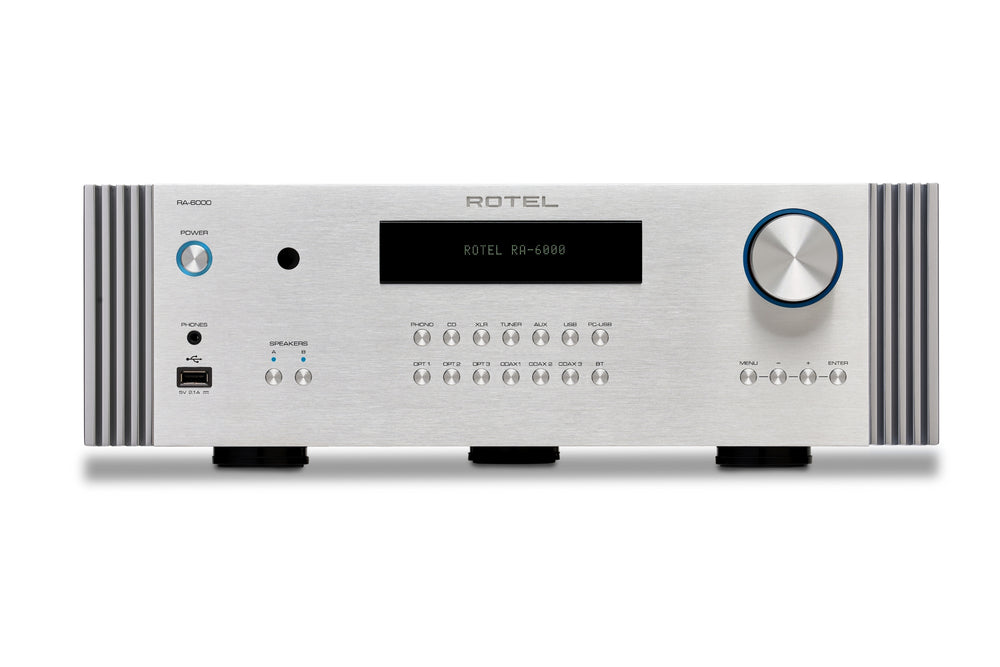
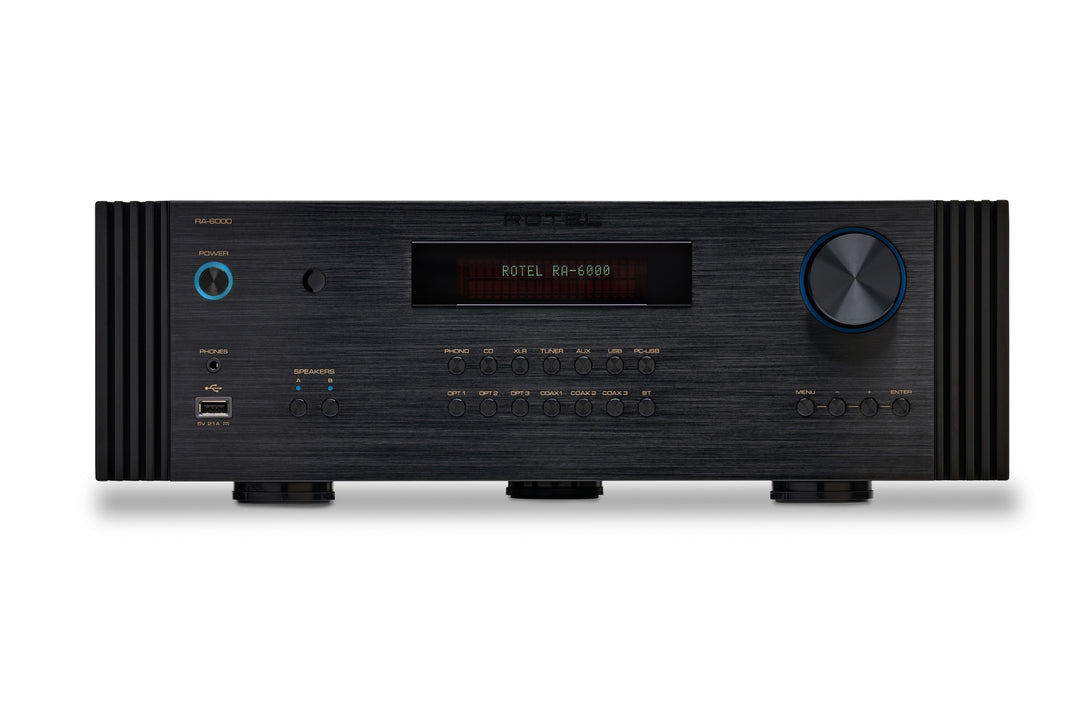
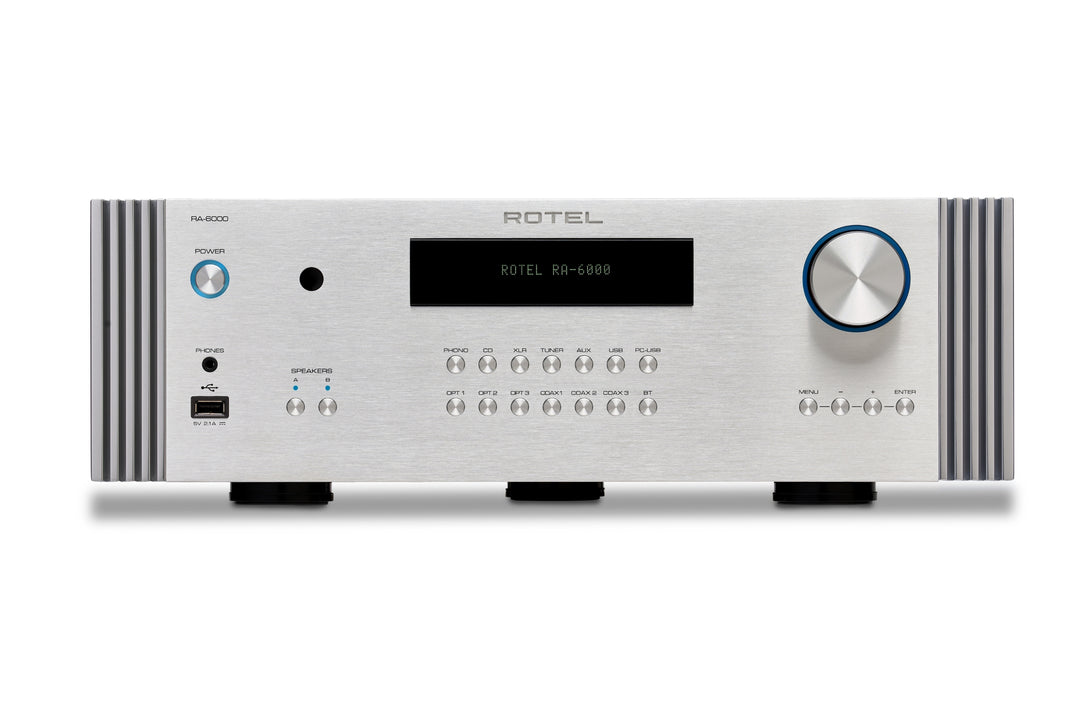
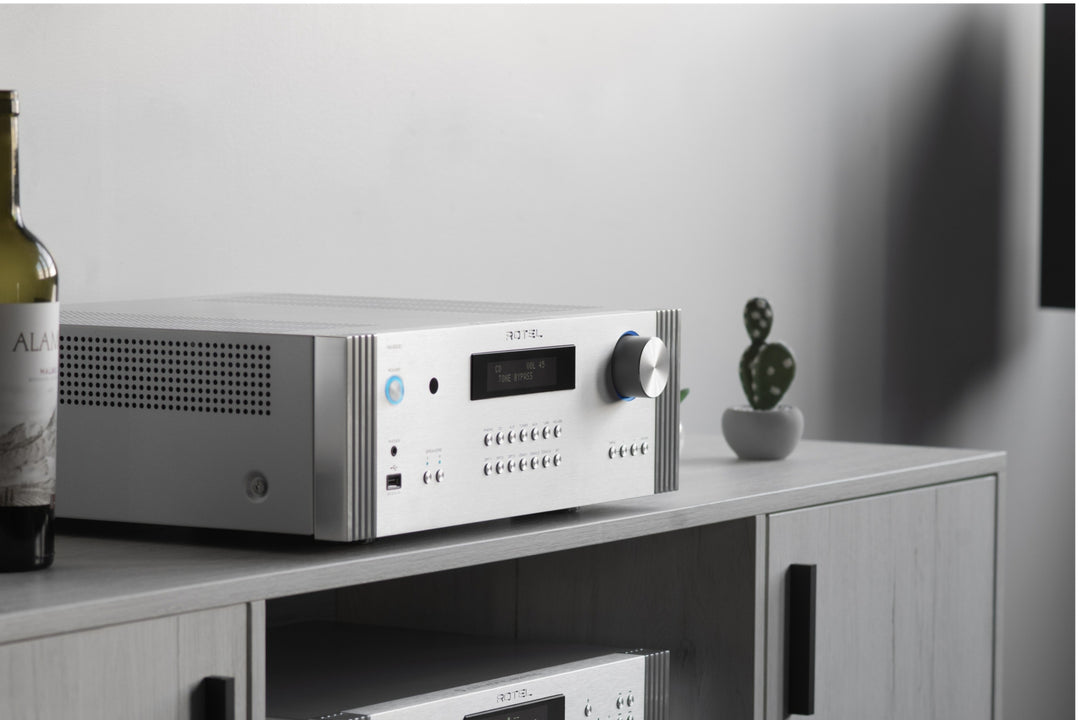
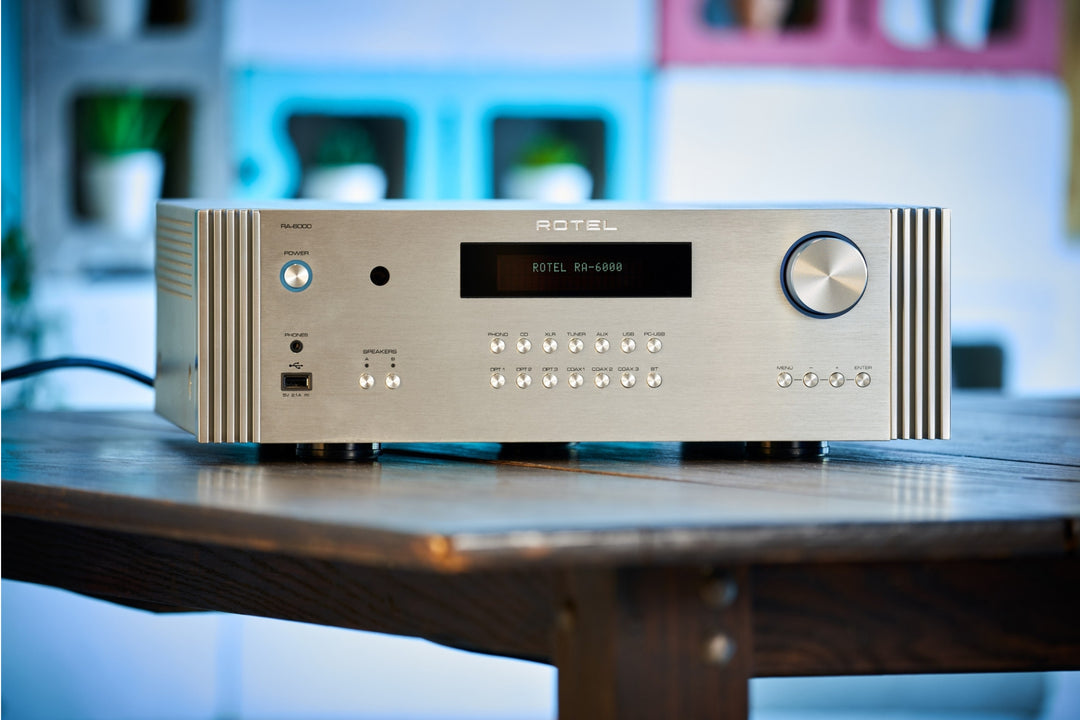
A stereo integrated amplifier from Rotel's Diamond Series, made to mark the brand's 60th anniversary. Rotel lists 350 watts per channel into 4 ohms, a Moving Magnet phono stage, balanced XLR and RCA inputs, coaxial, optical and PC-USB digital inputs, and aptX HD Bluetooth. Available in Black or Silver.
BACK IN BLACK Black finish is now available again, for a limited time.
Rotel says the Diamond Series RA-6000 celebrates 60 years of performance, passion and value synonymous with the brand's Japanese heritage. It plays analogue and digital sources through one amplifier, with two sets of speaker outputs.
Rotel on the RA-6000
Why you will love it
350 watts into 4 ohms, Class AB
Rotel lists 350 watts per channel (maximum, 4 ohm) and 200 watts per channel (continuous, 8 ohm), with total harmonic distortion below 0.0075%. Rotel describes the output as Class AB.
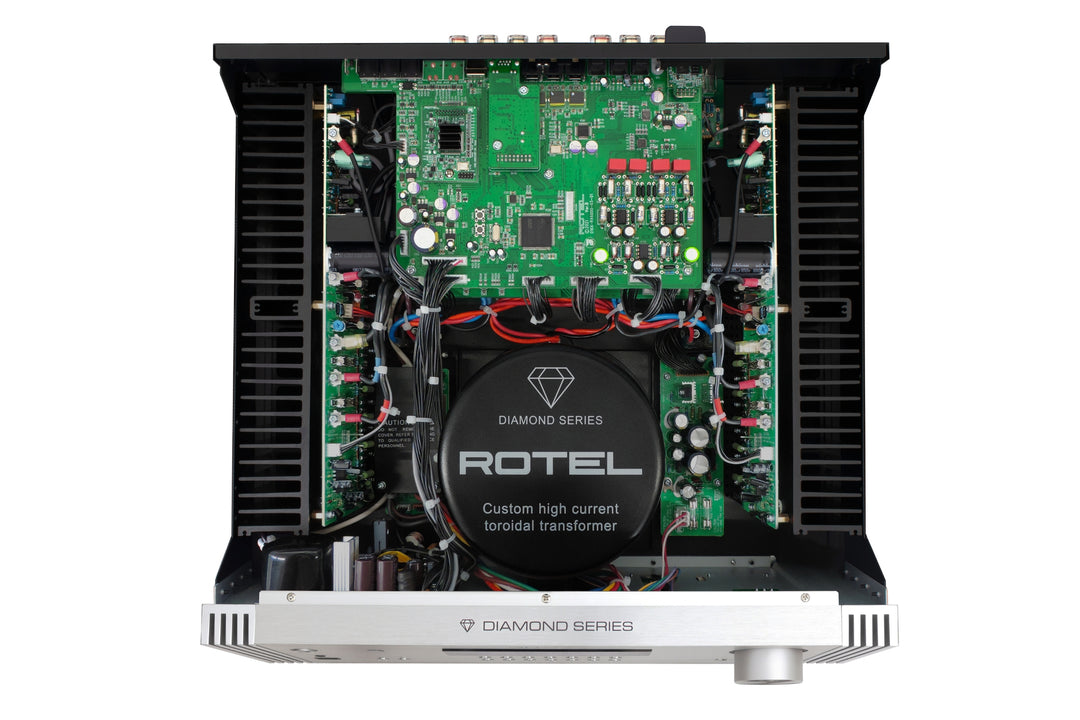
Rotel says an in-house manufactured toroidal transformer feeds dedicated power to the critical circuits, with low ESR slit-foil smoothing capacitors. Rotel says physical and electrical isolation techniques are used in the digital and high-gain amplifier circuits to reduce noise in the sensitive analogue stages.


Analogue, digital and wireless inputs
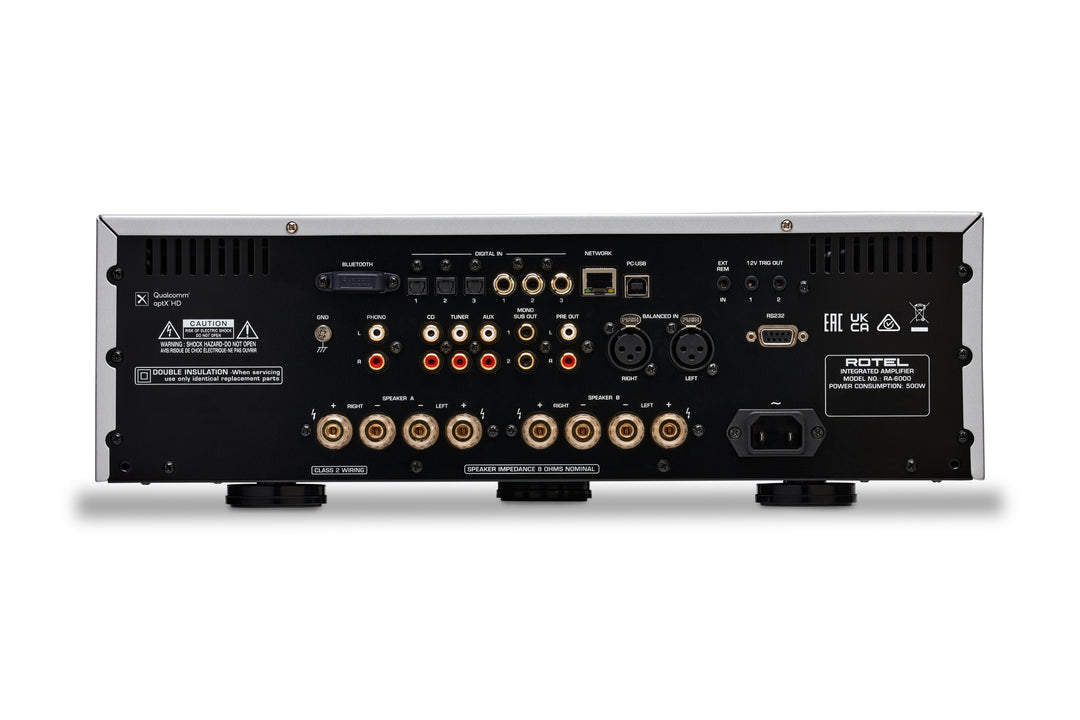
Analogue inputs are three RCA line inputs (CD, Tuner, Aux), one balanced XLR input and a Moving Magnet phono input. There are three coaxial and three optical digital inputs, an asynchronous PC-USB input, a front USB input for an iPhone, iPad or iPod, and Bluetooth with aptX HD and AAC.
Coaxial and optical inputs decode PCM up to 24-bit/192kHz. Digital sources go through a Texas Instruments 32-bit/384kHz converter.
PC-USB, MQA and Roon Tested
The PC-USB input uses USB Audio Class 2.0 and supports up to 32-bit/384kHz. Windows needs the driver supplied on the included USB stick. Macs do not need a driver. Rotel lists MQA and MQA Studio up to 24-bit/384kHz, and the RA-6000 is Roon Tested.
Many playback apps do not support 384kHz, so confirm your player and your files support it.

Outputs, controls and integration
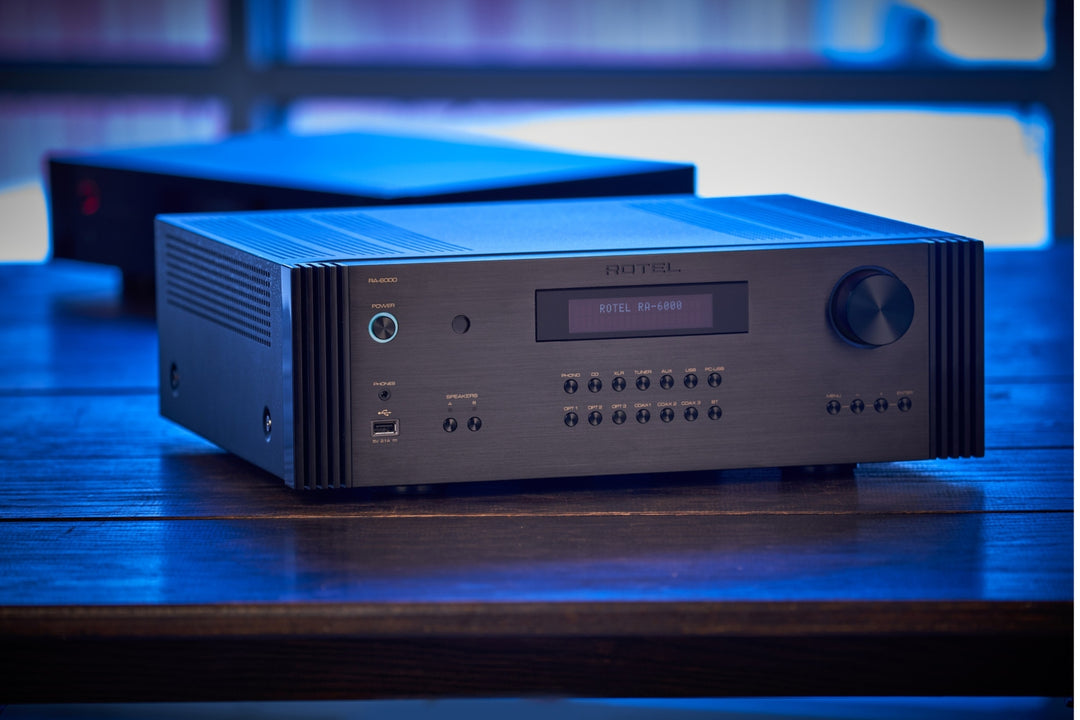
There are two sets of speaker outputs (A and B), a pre-out, two mono subwoofer outputs, and a 3.5 mm headphone output on the front panel. Bass and treble controls and a balance control are included; Rotel sets the tone controls to bypass by default.
Control connections are Ethernet, RS232, 12V trigger outputs and an external remote input. The Ethernet port is used for software updates and IP control. A back-lit RR-AX200 remote and a 2-line display handle everyday use.
Is it right for you?
A great fit if you…
- Want one amplifier for a turntable, CD player, computer and phone
- Want XLR and RCA analogue inputs plus coaxial, optical and USB digital inputs
- Want a pre-out or subwoofer outputs for system expansion
- Use Roon, MQA files or a Windows or Mac computer over USB
Worth knowing
- Phono is Moving Magnet only, so it suits MM cartridges
- The Ethernet port is for updates and control, and Rotel lists no network streaming
- Rotel lists no DSD and no HDMI
- Windows needs the supplied driver for 384kHz PC-USB playback
- Use either the RCA or the XLR inputs from one source, not both
- If both speaker sets A and B are used together, Rotel says all speakers should be 8 ohms or more
- Silver and Black are the available finishes
Build your system
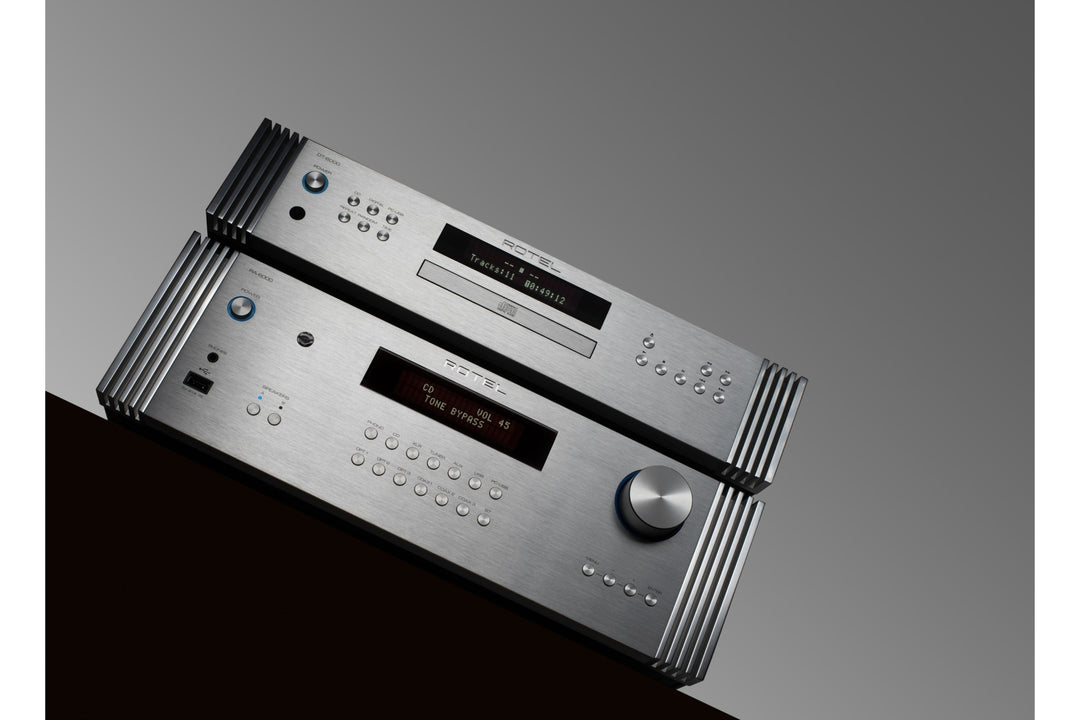
Rotel's DT-6000 manual shows the DT-6000 connected to the RA-6000 by RCA and by balanced XLR.
- CD player and DAC: Add the Rotel DT-6000 DAC Transport, shown with the RA-6000 in Rotel's connection diagrams, or browse CD players
- Streamer: For network streaming, add the Rotel S14 integrated network streamer
- Speakers: Add bookshelf speakers or floorstanding speakers
- Turntable: Use the MM phono input with a turntable
- Subwoofer: Add a subwoofer to the mono subwoofer output
Specifications
Amplifier
| Maximum power output | 350W/Ch (4 ohm) |
|---|---|
| Continuous power output | 200W/Ch (8 ohm) |
| THD | <0.0075% |
| Intermodulation distortion | <0.03% |
| Damping factor | 600 (20 Hz - 20 kHz, 8 ohm) |
| S/N ratio (IHF A-weighted) | Line 103 dB; digital 102 dB; phono 80 dB |
| Frequency response | Line 10 Hz - 100 kHz, 0 +/- 0.5 dB; digital 10 Hz - 90 kHz, +/- 2 dB; phono 20 Hz - 20 kHz, 0 +/- 0.5 dB |
Inputs and outputs
| Line inputs | RCA x3 (340 mV / 5.6 kohm); XLR (540 mV / 100 kohm) |
|---|---|
| Phono input | MM, 5.2 mV / 47 kohm |
| Digital inputs | Coaxial x3, optical x3: LPCM up to 24-bit/192kHz |
| PC-USB | USB Audio Class 2.0, up to 32-bit/384kHz (Windows driver required); MQA and MQA Studio up to 24-bit/384kHz; Roon Tested |
| DAC | Texas Instruments, 32-bit/384kHz |
| Other inputs | Front USB, Bluetooth (aptX HD, AAC), external remote input |
| Outputs | Speakers A and B, pre-out (1.9 V / 100 ohm), mono subwoofer x2, headphones (3.5 mm), 12V trigger |
| Control | Ethernet, RS232 |
Physical and power
| Dimensions (W x H x D) | 431 x 144 x 425 mm |
|---|---|
| Front panel height | 3U / 132.6 mm |
| Net weight | 18.81 kg |
| Power requirements | 230V, 50Hz (Rotel Asia-Pacific page) |
| Power consumption | 500 W |
| Standby power consumption | <0.5 W |
Specifications from Rotel's RA-6000 product page (Asia-Pacific, 230V), info sheet and owner's manual, checked November 2026. The 120V, 60Hz figure on Rotel's other pages is the US value.
What is in the box
- Rotel RA-6000 integrated amplifier
- RR-AX200 remote control with AA batteries (per owner's manual)
- USB stick with Windows driver (per owner's manual)
Questions people ask
How much power does it have?
Rotel lists 350 watts per channel maximum into 4 ohms and 200 watts per channel continuous into 8 ohms.
Does it have a phono input?
Yes, a Moving Magnet (MM) phono input. Rotel lists no Moving Coil input.
Can it stream over Wi-Fi?
Rotel lists Bluetooth with aptX HD and AAC, and an Ethernet port used for software updates and IP control. Rotel lists no network streaming.
Do I need a driver for the USB input?
Windows needs the driver on the supplied USB stick for USB Audio Class 2.0 playback up to 384kHz. Macs do not need a driver.
Can I add a subwoofer or a second amplifier?
Yes. It has two mono subwoofer outputs and a pre-out for another amplifier.
Can it drive two sets of speakers?
Yes, with speaker outputs A and B. If both are used together, Rotel says all speakers should be 8 ohms or more. A single set can be 4 ohms.