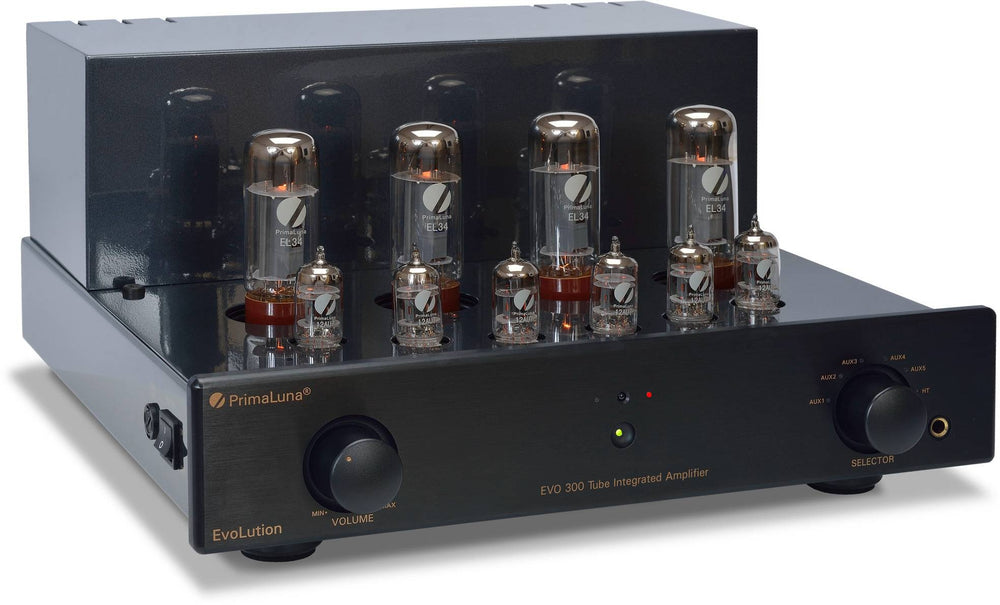
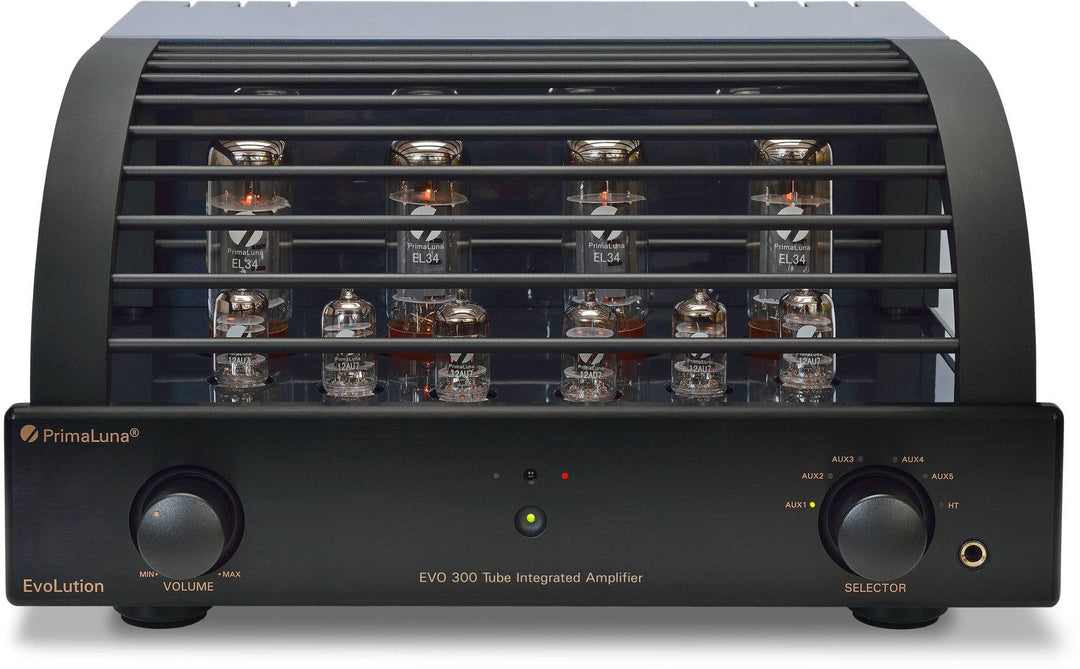
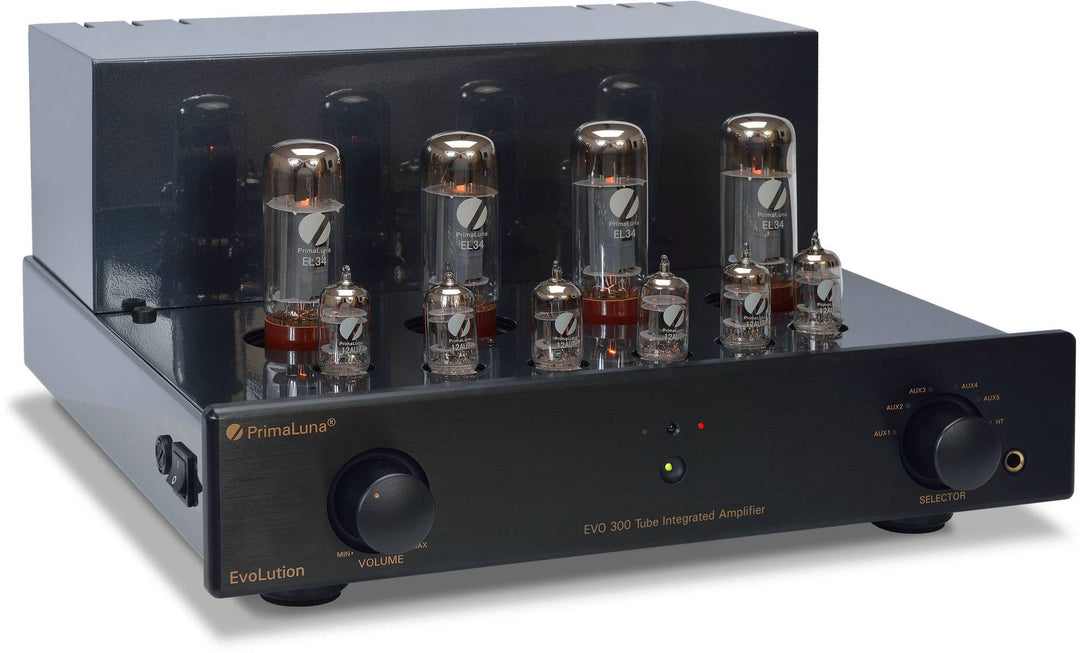
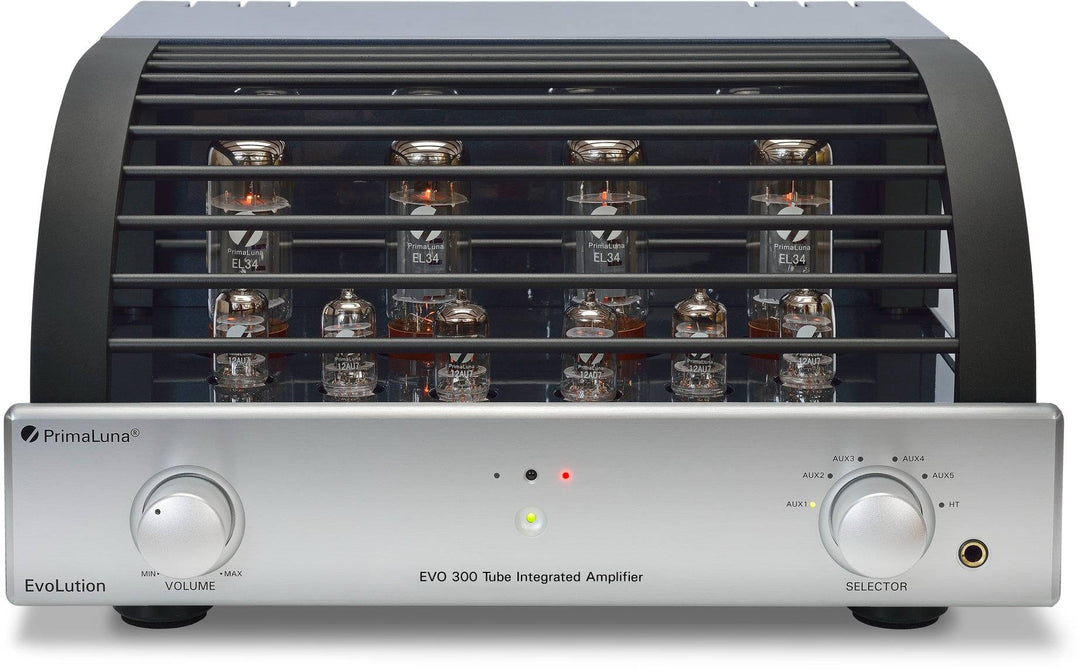
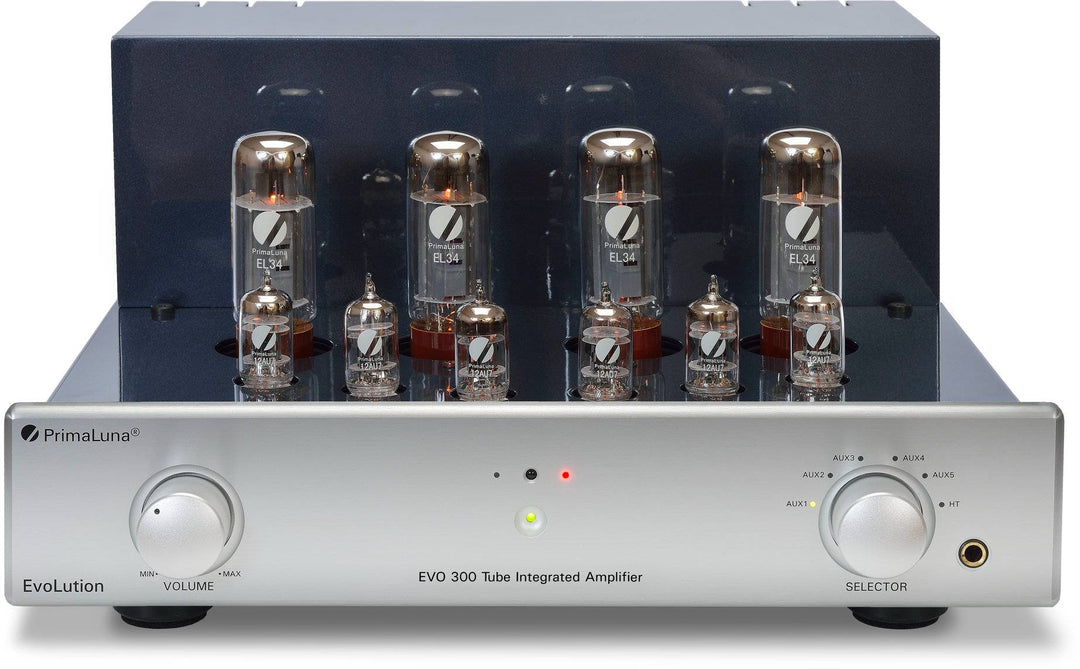
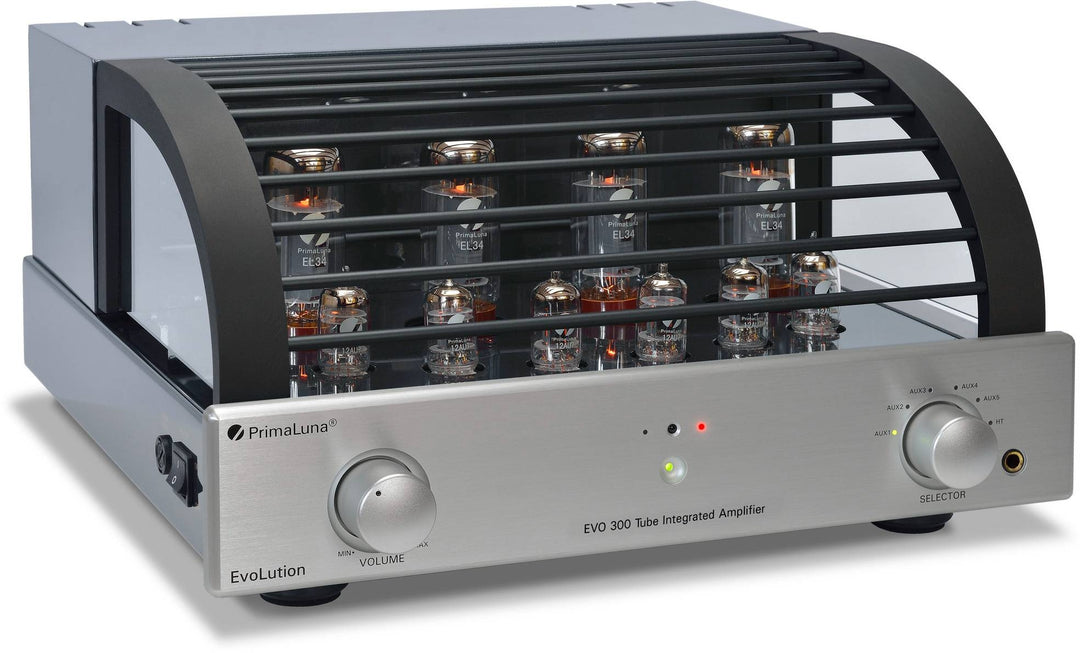
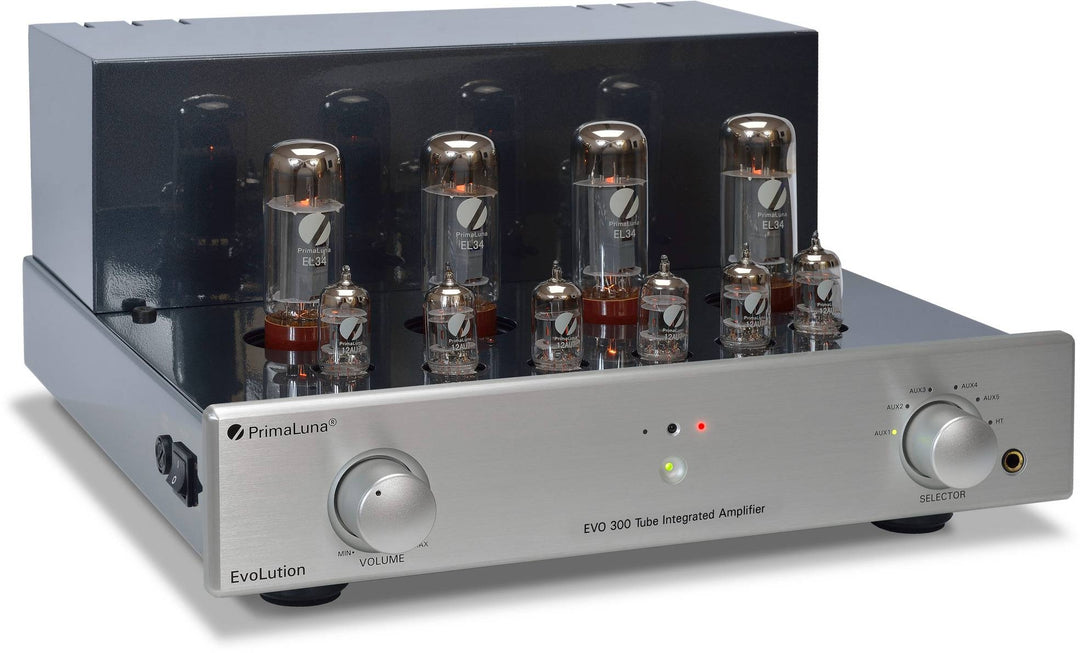
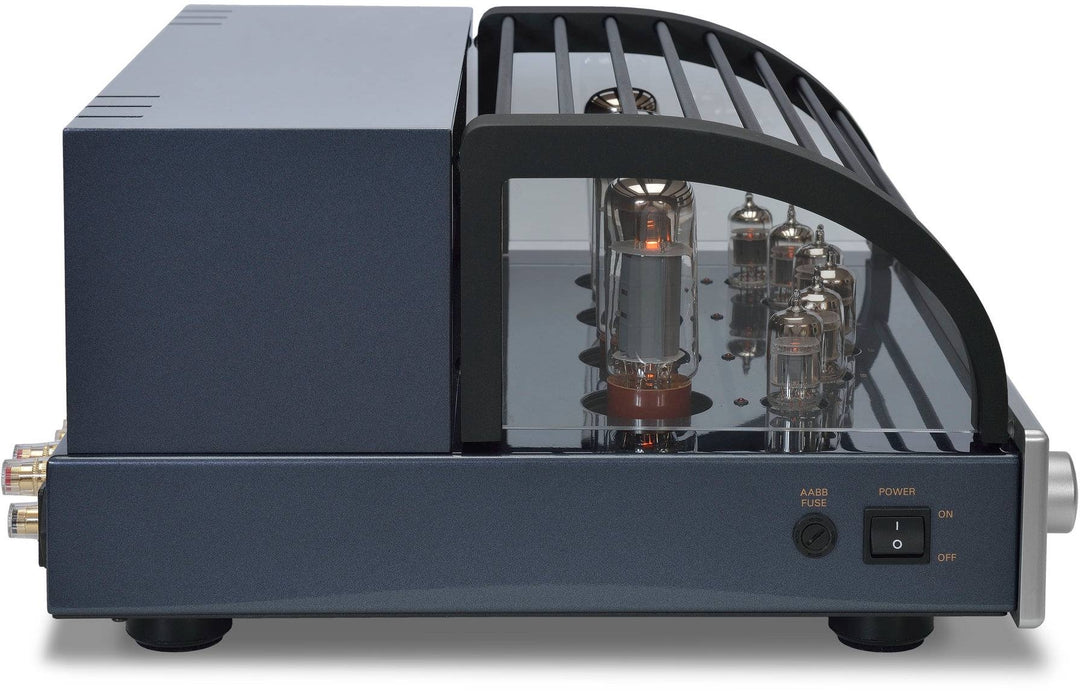
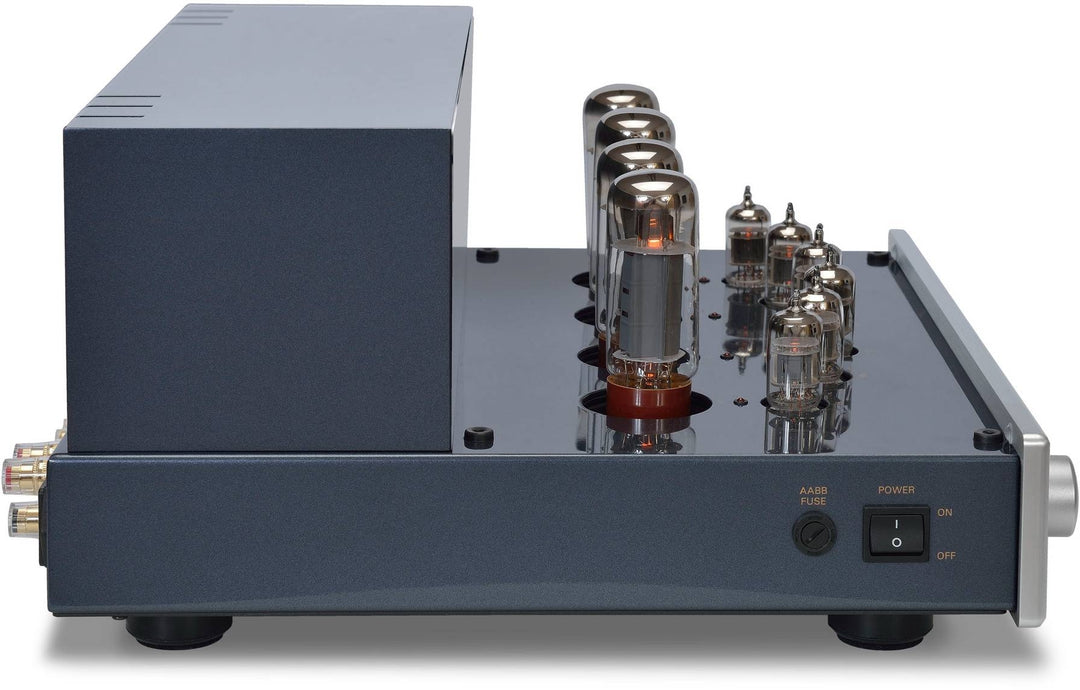
An all-tube integrated amplifier with 42 watts per channel in ultra-linear mode and 24 watts per channel in triode mode, switched from the remote. The PrimaLuna EVO 300 has five inputs, a home theatre bypass input, a subwoofer output and a tube-driven headphone output.
It is built with point-to-point wiring, potted toroidal power transformers and PrimaLuna's Adaptive AutoBias, so there are no bias adjustments to make when you change tubes.
PrimaLuna builds the EVO 300 without an internal DAC or phono stage as standard, and says external units are the better route. This page also offers a version with an MM phono stage.
PrimaLuna USA looks at the EVO 300 Integrated
Why you will love it
Built to be easy to own
PrimaLuna's Adaptive AutoBias monitors the tubes and adjusts bias in real time, out of the signal path. PrimaLuna says this removes the need for manual biasing, and the amplifier also has a high/low bias switch for choosing between EL34 and KT88 tubes.
If a power tube fails, the amplifier goes into protection mode and a red LED lights in front of the tube that needs replacing. PrimaLuna says you only replace that tube, with no matched sets required.

Hand-wired signal path
The signal path is hand wired point to point with heavy-gauge cable. Inputs are chosen by sealed Fujitsu relays mounted at the rear, next to the input sockets, instead of a front-panel switch with long internal leads. Volume is set by a motorised ALPS Blue Velvet control.
EVO 300 and EVO 400 use Swiss-made silver-plated OCC copper wiring with a Teflon dielectric in the signal path, along with Takman resistors and DuRoch tinfoil capacitors. PrimaLuna also fits its AC Offset Killer circuit to lower transformer noise.
Triode or ultra-linear at the push of a button
The remote switches between triode and ultra-linear operation while you listen. PrimaLuna says triode gives a warmer, fuller sound and ultra-linear gives more power, extension and dynamic contrast.
On the EVO 300 and EVO 400 the same switch also applies to the headphone output.
Tube-driven headphone output
PrimaLuna says there is no separate chip amplifier for the headphone socket, so the headphone output uses the same tubes as the main circuit. The socket is a 6.3mm jack on the front panel.
Connections and tube choice
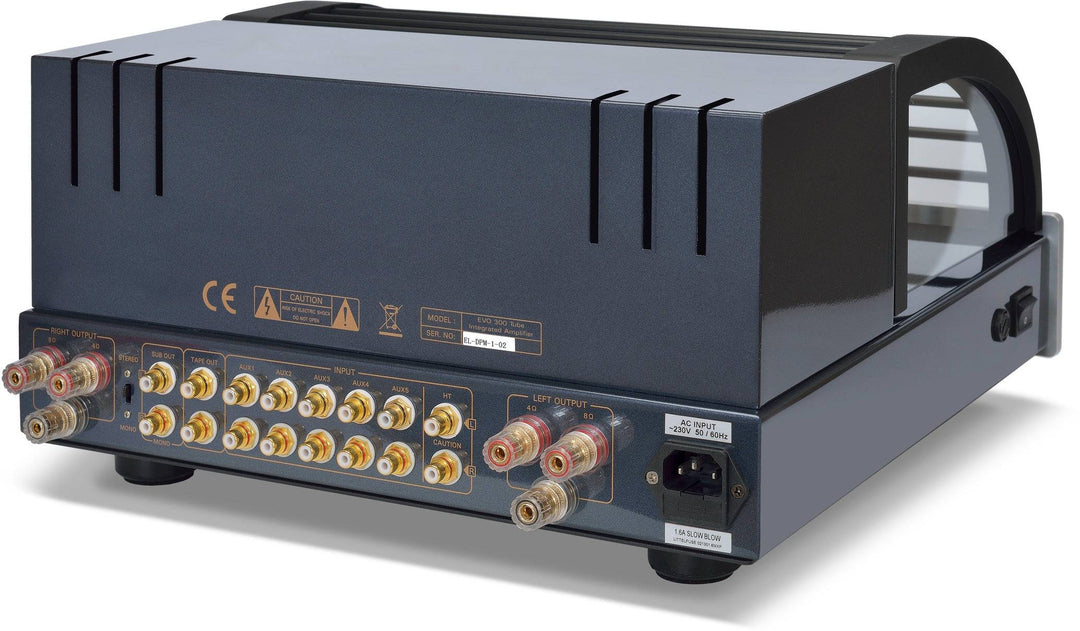
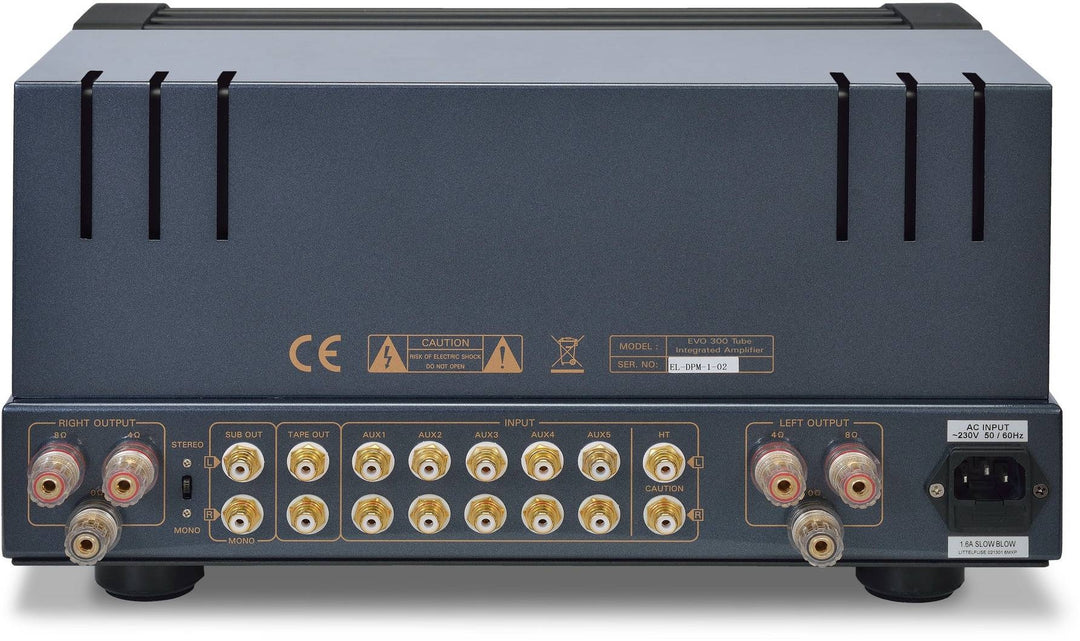
It has five stereo RCA inputs plus a home theatre bypass input, a tape output, a stereo or mono subwoofer output and 4 and 8 ohm speaker taps. The EVO 300 has a full function remote.
PrimaLuna lists these output tube types as compatible: 6L6G, 6L6GC, 7581A, EL34, EL37, 6550, KT66, KT77, KT88, KT90 and KT120, and KT150.

Is it right for you?
A great fit if you…
- Want to switch between triode and ultra-linear from the listening chair
- Need a subwoofer output on a tube amplifier
- Want a full function remote
- Like the idea of trying different power tubes, including KT150
Worth knowing
- It has no DAC. If you want digital inputs, add an external DAC such as the PrimaLuna EVO 100 Tube Digital Analogue Converter
- There is no phono stage as standard. Choose the MM Phono Stage version, or add an external phono preamplifier such as the PrimaLuna EVO 100 Tube Phono Preamplifier
- It is a large amplifier at 31kg, so it needs a sturdy shelf or rack
Build your system
PrimaLuna builds the EVO range to work together, so you can start with this integrated and add matching components later.
- Speakers: Pair with floor-standing speakers or bookshelf speakers; the 4 and 8 ohm taps suit most loudspeakers
- Turntable: Add a turntables and the PrimaLuna EVO 100 Tube Phono Preamplifier, or choose the MM Phono Stage version
- Digital: Add the PrimaLuna EVO 100 Tube Digital Analogue Converter for streaming and digital sources
- Step up or down: Compare with the PrimaLuna EVO 200 Tube Integrated Amplifier or the PrimaLuna EVO 400 Tube Integrated Amplifier in the same range
- Headphones: Plug in headphones using the front 6.3mm socket
Specifications
Power and sound
| Output power (ultra-linear, EL34) | 42W per channel |
|---|---|
| Output power (triode, EL34) | 24W per channel |
| Frequency response | 10Hz to 50kHz, ±1dB |
| THD (AABB) | <0.2% at 1W, under 2% at rated power |
| S/N ratio | 86dB |
| Input impedance | 100kΩ |
| Input sensitivity (EL34) | 270mV |
| Maximum gain (EL34) | 36.5dB |
| Damping coefficient | 4 (1kHz) |
Connections
| Inputs | 5 pairs stereo RCA, plus 1 pair home theatre bypass |
|---|---|
| Outputs | 4 and 8 ohm speaker taps, tape out, 6.3mm headphone, stereo or mono subwoofer out |
| Remote control | Full function |
Tubes and design
| Standard tube complement | 4 x EL34, 6 x 12AU7 |
|---|---|
| Power consumption (EL34) | 290W |
| Finish | Black or silver, five-coat hand-rubbed finish |
| Dimensions (W × H × D) | 38.5 × 20.5 × 40.5 cm |
| Weight | 31kg (68.2lb) |
Specifications from PrimaLuna, checked November 2026.
Questions people ask
Does it have a phono input?
There is no phono stage built in as standard. PrimaLuna lists an optional PhonoLogue EVO moving magnet phono stage as compatible, and this page has an MM Phono Stage version. For moving coil cartridges, or to choose your own phono stage, use an external unit such as the PrimaLuna EVO 100 Tube Phono Preamplifier.
Does it have a DAC?
No. PrimaLuna builds its integrated amplifiers without a DAC. Connect an external DAC to any line input, for example the PrimaLuna EVO 100 Tube Digital Analogue Converter.
Which tubes does it use?
It ships with 4 x EL34, 6 x 12AU7. PrimaLuna lists 6L6G, 6L6GC, 7581A, EL34, EL37, 6550, KT66, KT77, KT88, KT90 and KT120, and KT150 as compatible output tubes.
Do I need to adjust the bias when I change tubes?
PrimaLuna's Adaptive AutoBias sets bias automatically. The amplifier has a high/low bias switch so you can choose the setting for EL34 or KT88 tubes.
Can I use it with headphones?
Yes. There is a 6.3mm headphone socket on the front panel, driven by the amplifier's tube circuit rather than a separate chip.
Can I connect a subwoofer?
Yes. It has a stereo or mono subwoofer output on the rear panel.
How do I switch between triode and ultra-linear?
Use the remote control. PrimaLuna says the switch works while music is playing.